
Factory HT Antenna (Rubber Ducky)

As a new ham, are you frustrated and unhappy over the performance of your handheld transceiver (HT)?  Maybe not reliably hitting a repeater, or struggling to make radio-to-radio (simplex) contacts work?

A good place to start is found in our post on HT improvements , where you will learn that the factory/stock antenna is a real limitation to on-air performance. But why is this the case?  This post adds a lot of detail to address that question.

As indicated in the 2018 and 2022 Technician class license exam questions and answers, the main reason is that the factory antennas for VHF/UHF handhelds are inefficient, often terribly so. The manufacturers ship HTs with stubby “rubber duck” flexible antennas. Mainly because they mostly work, and likely also because hams often wear their radios on their chest or belt and don’t want a 19″ thing sticking up. The cynic in me also suggests because shipping a proper 2m VHF antenna requires a 2ft long box, and that makes storage and delivery a lot more expensive.
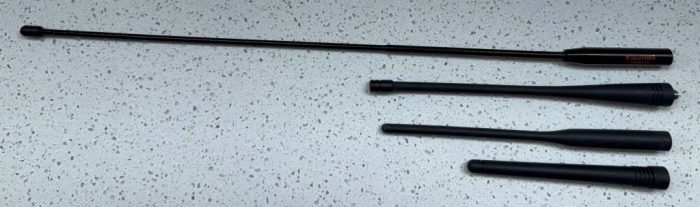
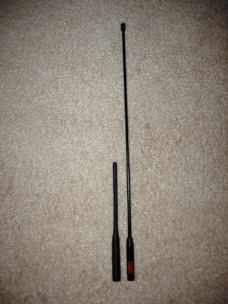
The photo above shows an assortment of 2m/70cm HT antennas; the lower three in varying lengths are all stock from different radio manufacturers. For reference, a nearly full 1/4-wave whip with excellent performance measures about 16″ long.

To make these shortened antennas work at all, they must reasonably match the 50Ω impedance the radio wants to see. The usual trick with shortened antennas is to coil some wire in the antenna to form inductance which offsets capacitive reactance resulting from the shortened conductor.  There may be more than one coil inside the casing, along with a small capacitor, depending on construction; the designs vary.

Technically, the rubber duck is a normal mode helix antenna. A surprisingly good Wikipedia article with further links is found here.  As with other electrically short antennas the rubber duck has poorer performance due to losses and much less gain than a 1/4-wave monopole.

Why so inefficient?  These “rubber duck” antennas are almost entirely coils inside. Antenna coils will convert much of their RF current to heat when transmitting instead of radiating most of the signal as desired.  Some hams refer to shortened HT antennas as “rubber resistors” for this reason. 

How much loss? It’s tricky to say. Ham K0NR actually set up a test to compare and says, “I’ve measured the radiated signal strength of a number of 2m rubber duck antennas, comparing them to a halfwave antenna. The performance varied quite a bit depending on the specific duck antenna but was in the range of 8 dB to 12 dB worse than the halfwave.”  For reference, 3dB is half power, 6dB is quarter, 9dB is 1/8, 12dB is 1/16 power, which should give you a good notion of performance. Not even in the same ballpark.

Now, if you are 100ft away from another ham working simplex, it probably won’t matter and the rubber ducks will be fine. You’re playing in a different ballpark. If you work only UHF frequencies, you may not notice the inefficiency as much as at 2m VHF, as the 1/4-wave antenna for 70cm is much closer to the short stock length.  At a distance, or if you’re not reliably being heard, the short antenna may be your problem. We recommend that you get a good 1/4-wave whip to have on hand for when it’s really needed, especially in an emergency response or similar critical situation.

If you’re curious to see what’s inside Continue reading

HT Antenna Improvement

The handheld transceiver (HT) is likely a new ham’s first radio.  This VHF/UHF rig is relatively inexpensive, compact and fairly useful for local communication via repeater or simplex operation.

Unfortunately, HT  performance is typically limited by its low power and cheap factory antenna.

T9A04-2018

There are three easy ways to improve the HT antenna.  These ideas are from our post on Understanding Antennas but we wanted to elaborate a bit on them here.

The first improvement is to get a 2m ¼-wave or 5/8-wave whip antenna.

This 2m ¼-wave whip is much longer (~19″) compared to the factory antenna but gives dramatically better performance (roughly equivalent of 5x power):

QW whip

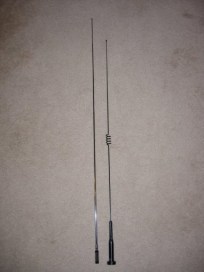
This telescoping 5/8-wave whip should (in theory) perform better than the ¼-wave monopole (shown with 5/8-wave mobile whip):

5_8 Whip

These two antennas can be purchased new in the $20-30 range; well worth the money.

While the antenna can be improved with a longer whip, vertical monopole performance is also limited by the HT’s indirect ground plane.

The counterpoise that makes the vertical monopole behave like a λ/2 dipole on a HT is the operator’s body.  It is capacitively coupled to the ham’s body through the plastic case and metal shell around the RF circuitry.

This indirect counterpoise coupling is not only weak but also highly variable and unpredictable.

The good news is that we can improve the counterpoise simply by adding a wire to the HT antenna connection.

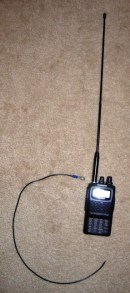
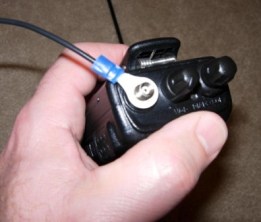
By connecting a ¼-wave  wire (~19” for 146MHz) to the antenna connector outer terminal, we create a physical counterpoise in place of the indirect ground plane through the operator’s body.

This gives superior performance under difficult conditions and is easy to do.

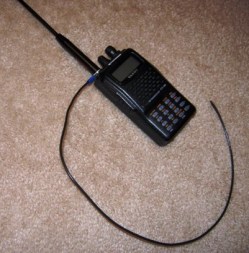
These physical counterpoise wires are known as rat tails or tiger tails due to their appearance.

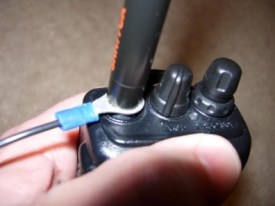
Rat tail counterpoise installation is quick and easy.  Simply unscrew the antenna, slip the rat tail over the connector and re-attach the antenna

tiger tail1

tiger tail2

tiger tail3

tiger tail4

The rat tail can simply hang down in a gentle arc where it won’t be much in the way of anything. Even better, you can hold the wire out  in the direction of communication.  Gain/directivity is achieved Continue reading

Going Mobile

The Who had a hit tune entitled Going Mobile that may be playing in your head right now.  While the song celebrates the joy of living in a mobile home and traveling caravan-style in the UK, going mobile to hams means using radio equipment in your vehicle.

While some hams have HF radio setups in their cars, mobile predominantly means local VHF/UHF communication.  Besides bring able to talk to our ham buddies while driving around, 2m/70cm capability is particularly useful in case of disaster or other emergency communication (EmComm) situations.  It is perfect for storm spotting and certain public service events.

Mobile operation is popular and important enough that there are a number of US license exam questions involving the topic as you will see below.

Installing and using amateur radio equipment in one’s personal vehicle is too large a topic to cover here so we’ll simply advise you to research details on your own.  Talk to fellow hams and see what/how/why they installed their own gear.

The internet is also a vast resource for [mostly good] info .  One noteworthy site dedicated to mobile ham operation is managed by Alan Applegate, K0BG, and is located here.   It contains exceptionally useful info on most topics presented below.  We encourage you to use this site as a primary reference for your own mobile radio installation and operation.  The ABCs topic is the best place to start.

Before embarking on any of this yourself, there are several important points to consider:

  • Radio type
  • Radio control location
  • Radio mounting
  • Radio power wiring
  • Antenna type and mounting
  • Radio audio/speaker
  • Transmitting while driving
  • Hands-free/Distracted driving laws
  • Noise and interference

We will scratch the surface of each of these topics here:


Radio type-  Choose a mobile radio that best fits your needs, desires, and budget based on several factors:

  • Brand– quality/reliability and/or familiarity/loyalty
  • Transmit power (Watts)
  • Features– Auto power-off, APRS, dual-channel, remote head, cross-band, packet
  • VHF/UHF (V/U) or HF?
  • FM only, or multi-mode?
  • Single-band, dual-band, tri-band, or quad-band?
  • Analog or digital communication, or both?
  • New, reconditioned, or used?

Note that while a hand-held transceiver (HT) can be used in a car, it is significantly limited by its antenna and transmit power.  Both can be improved (linear amplifier and external antenna) but if you really want good mobile performance you should consider a purpose-specific mobile radio.


Radio control location-  Modern mobile transceivers typically feature removable front panels where the operator controls can be positioned in a more convenient, ergonomic, and safe location using a smaller footprint. Continue reading

Public Service Events

Are you a new ham who wants to practice radio communication?

Just getting started in amateur radio and want to learn about emergency communications (EmComm)?

Are you a ham who wants to make better use of your hobby?

If you answered yes to any of these, consider helping with a local public service event (PSE). Public Service Events provide an excellent chance to practice your EmComm radio skills.  Not only is it fun and interesting, but you will gain valuable experience in radio communications similar to a real disaster scenario, without the stress and urgency of a life and death situation.

pse-hams

Ham radio operators are often invited to assist with PSEs to provide primary or supplementary communication.  PSEs typically involve parades, races or large gatherings.  They normally use VHF/UHF radios so you don’t need any fancy equipment or big antennas.

Participants may be stationary  or mobile, depending on the nature of the event.  You may be sitting or standing or walking around.

Because hams supporting a PSE will often use a handheld transceiver (HT) it’s a good idea to have a few recommended HT accessories.  First would be a quality 1/4-wave antenna in place of the poorly-performing factory “rubber duck”.  Second is a spare battery pack for your radio.  Third would be headphone(s).

A must-read for new hams is Continue reading

Don’t Settle for Just a HT

zys-ft-60r

Often a new ham’s first radio is a handheld transceiver (HT).  A HT represents the lowest-cost entry point to amateur radio and is relatively easy to set up and use.  Your first on-air experience as a licensed ham may involve a HT on a local VHF/UHF repeater, and that’s fine.

But don’t settle for just a HT as supplied by the manufacturer for your early ham radio experience.  You are almost certainly going to be frustrated and disappointed at its performance to the point of giving up on ham radio and wondering why all these hams are so enthusiastic about the hobby.

Don Keith N4KC makes this point eloquently  in his ‘HT Trap’ article where he discusses how easily a new ham can get discouraged with amateur radio because of the limitations of a stock HT.  I have observed this as well while helping new hams get set up in a local EmComm organization.

Huge improvements in HT performance or ease of use can be accomplished with three accessories.


First and foremost is the Continue reading

Get on the Air Now!

An outstanding resource for amateur radio operators, and new or prospective hams in particular, is a paperback book by Don Keith N4KC entitled, GET ON THE AIR…NOW!


There is something for everyone here: Folks who are interested in ham radio, those who just got a license, experienced hams who lose interest, and long-time hams who are looking for something to share with newbies. N4KC covers most of what current and prospective ham radio operators need to know and he does a great job of selling the hobby/interest. And no, he’s not pushing Morse code, although CW operation is one of the more interesting aspects of amateur radio.

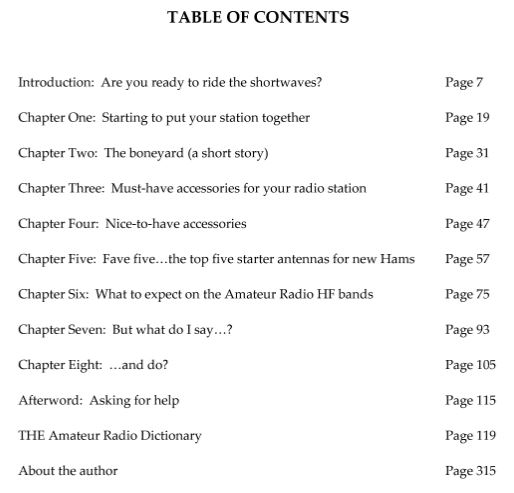
The main emphasis of the book is encouraging licensees to actually get on the air and experience real ham radio, not to get frustrated with bad experiences and limited equipment and then give up on our hobby.  He addresses some of the common discouragements and steers us to realistic remedies.  Chapter five is a practical discussion of antennas and I particularly appreciate chapter six with Don’s concise description of what to expect on the HF bands.

gotan TOC

The second half of the book is a comprehensive dictionary of “ham-speak”–amateur radio terms, abbreviations and slang, useful to all hams, new and old.

About $19 with a Kindle version for $9.  Highly recommended and the first item listed on a new site page entitled Recommended Reading.

Stuck Microphone

While it’s mainly a local VHF/UHF communications issue, stuck microphones can be a real problem.

A stuck mic situation is when a radio operator inadvertently transmits for an extended time because they have unintentionally triggered the push to talk or transmit switch on their radio.  Consequences of a stuck mic range from being a nuisance to a life-threatening disruption. At best a stuck mic ties up a repeater or simplex frequency with dead air or noise.  At worst it blocks urgent communication during a disaster net or public service event.

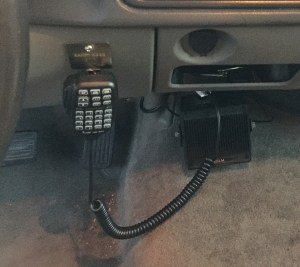
One common stuck mic situation involves a mobile unit with the hand-held mic loose in the vehicle where it might get wedged into the seat to trigger the PTT button.  Best practice here is to keep the mic clipped into a hanger when not being used to minimize inadvertent transmission.

mobilemicclipped
Keeping a mobile mic secure in clip minimizes chance of inadvertent keying.

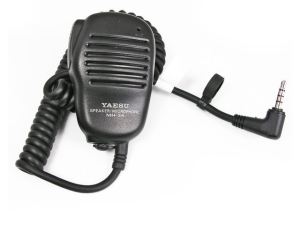
Another common situation involves mic accessories with HTs during a public service event or emergency deployment.  When using a speaker-mic or headset, ensure that the PTT button is protected from accidental triggering.  Also, the Yaesu FT-60 is a wonderful handheld radio and many hams have them, but they (and others like them) have a squirrely speaker/mic jack that is prone to false triggers when the connector is not seated completely.  So make sure your accessory is connected securely and not prone to pulling out when the radio is clipped to your belt or in a pocket or something like that.

yaesu-spkr-mic
External mic or headset prone to false PTT triggers because of plug design on certain HTs.

In any case, awareness is our first line of defense.  Be aware that a stuck mic is a problem and that you might be the culprit.

stuckmicmeme
Don’t be this guy!

Keep an eye on your transmit light to make sure it’s not on when Continue reading

Know Your Radio

Do you know how to change the settings on all of your radios?  You should, particularly with the VHF/UHF rigs that would be used in an emergency situation in case of a local disaster.

It may seem silly to ask this question when such knowledge is often assumed.  But consider these factors:

  • Many of the modern radios can be configured via software on a PC, often including memory channels for local repeaters.  Did you actually set up your radio manually, or was it cloned or computer configured?
  • Many hams have multiple transceivers- handhelds (HTs), mobile, and base station rigs.  Configuration of these is likely different for each model, even with the same manufacturer.
  • Hams may have different makes of the same type of radio as well, each with very different configuration procedures.  If you have both Yaesu and  Baofeng HTs, the procedures will be quite different.

Consequently some hams only know how to turn the radio on and off, adjust the volume and squelch, and then select a memory channel to work a local repeater.  This is OK when you want to chat with a buddy, since little can go wrong and there are no real consequences.

But during a drill, public service event or EmComm deployment, we have to be flexible and prepared to change things up.  There are many reasons things don’t go as planned, and you may have to change a setting on your radio.  Even something as simple as communicating outside the local area will require different repeater access tones.  Some events use a portable repeater that you may not have programmed into your radio.  Many of us have been embarrassed in the field when Continue reading

Keep That HT Antenna Vertical

The previous post introduced you to the handheld transceiver (HT) and suggested that it had limitations.

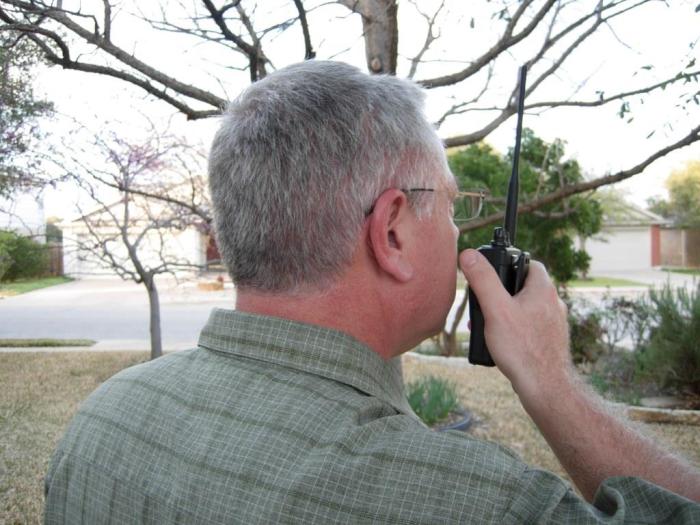
One of the HTs weaknesses is that because it is hand held, the operator must maintain the antenna pointing up for maximum performance, as shown below.

DSCN4227

This is because repeater and mobile antennas are always vertically oriented and the handheld antenna should match orientation for maximum power transfer.

T3A04-2018

Antennas are polarized according to Continue reading

The Handheld Transceiver (HT)

A handheld transceiver (HT) is often a new ham’s first radio.  As the name suggests, it is small enough to hold in your hand and has enough performance to be useful under many circumstances.

zys-ft-60rThe appeal of a HT is in its relatively low cost plus its obvious portability.  Some new hams want to spend as little as possible to get started in amateur radio and new HTs can be had for less than $50 (although not recommended by experienced hams).  Other new hams get started with a local emergency communications group which uses them.  Still others simply want a radio for keeping in touch with others while hiking or some other outdoor activity.

These radios have a practical range of one to three miles from one HT on the ground to another.  This is limited mostly by power and terrain or obstructions.  Greater range is achieved by operating from an elevated position or through the use of repeaters (refer to the repeaters topic).

Amateur use of handhelds is most common on the 2m (146MHz) VHF and 70cm (435MHz) UHF bands using frequency modulation (FM).  HTs are available for a few other VHF and UHF ham bands as well, depending on local usage and repeater support.  While HTs can be found for upper HF bands, antenna length makes them less practical as handheld devices.

Dual-band HTs are quite common and practical, costing little more than a single-band radio.  Many of these also allow the user to receive non-ham band transmissions such as weather alerts, aircraft, and police-fire-EMS dispatching.

While useful in some situations, HTs have limitations for ham radio use.  To obtain reasonable battery life a HT Continue reading

Understanding Antennas-A Simplified Perspective

A PowerPoint slideshow, Understanding Antennas / A Simplified Perspective for Ham Radio Operators is downloadable here: Understanding Antennas-A Simplified Perspective

This presentation provides a working understanding of amateur radio antennas without being overly technical or dry.

The target audience is newer hams with limited knowledge of antennas.  It is presented at the Technician license level. You will see Continue reading