
 As a new ham, are you frustrated and unhappy over the performance of your handheld transceiver (HT)? Maybe not reliably hitting a repeater, or struggling to make radio-to-radio (simplex) contacts work?
A good place to start is found in our post on HT improvements , where you will learn that the factory/stock antenna is a real limitation to on-air performance. But why is this the case? This post adds a lot of detail to address that question.


As indicated in the 2018 and 2022 Technician class license exam questions and answers, the main reason is that the factory antennas for VHF/UHF handhelds are inefficient, often terribly so. The manufacturers ship HTs with stubby “rubber duck” flexible antennas. Mainly because they mostly work, and likely also because hams often wear their radios on their chest or belt and don’t want a 19″ thing sticking up. The cynic in me also suggests because shipping a proper 2m VHF antenna requires a 2ft long box, and that makes storage and delivery a lot more expensive.
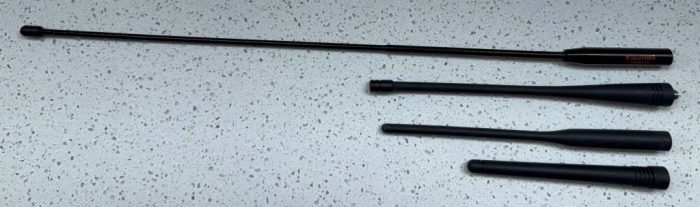
The photo above shows an assortment of 2m/70cm HT antennas; the lower three in varying lengths are all stock from different radio manufacturers. For reference, a nearly full 1/4-wave whip with excellent performance measures about 16″ long.
To make these shortened antennas work at all, they must reasonably match the 50Ω impedance the radio wants to see. The usual trick with shortened antennas is to coil some wire in the antenna to form inductance which offsets capacitive reactance resulting from the shortened conductor. There may be more than one coil inside the casing, along with a small capacitor, depending on construction; the designs vary.
Technically, the rubber duck is a normal mode helix antenna. A surprisingly good Wikipedia article with further links is found here. As with other electrically short antennas the rubber duck has poorer performance due to losses and much less gain than a 1/4-wave monopole.
Why so inefficient? These “rubber duck” antennas are almost entirely coils inside. Antenna coils will convert much of their RF current to heat when transmitting instead of radiating most of the signal as desired. Some hams refer to shortened HT antennas as “rubber resistors” for this reason.
How much loss? It’s tricky to say. Ham K0NR actually set up a test to compare and says, “I’ve measured the radiated signal strength of a number of 2m rubber duck antennas, comparing them to a halfwave antenna. The performance varied quite a bit depending on the specific duck antenna but was in the range of 8 dB to 12 dB worse than the halfwave.” For reference, 3dB is half power, 6dB is quarter, 9dB is 1/8, 12dB is 1/16 power, which should give you a good notion of performance. Not even in the same ballpark.
Now, if you are 100ft away from another ham working simplex, it probably won’t matter and the rubber ducks will be fine. You’re playing in a different ballpark. If you work only UHF frequencies, you may not notice the inefficiency as much as at 2m VHF, as the 1/4-wave antenna for 70cm is much closer to the short stock length. At a distance, or if you’re not reliably being heard, the short antenna may be your problem. We recommend that you get a good 1/4-wave whip to have on hand for when it’s really needed, especially in an emergency response or similar critical situation.
If you’re curious to see what’s inside your factory antenna without destroying it, other hams have done that for us and pics can be viewed here and here.
A couple of web references to factory short HT antennas are found below:
How much does a rubber ducky antenna degrade VHF transmission range?
Inventor’s Origin History (scroll down)
 NewHams.info